
News · Case study
Yvetot: Building territorial mobility, from the urban network to demand-responsive transport
Interview with Louis Mazars, Sales Director of Cars Hangard, operator of the Vikibus transport network of the Communauté de communes Yvetot-Normandie, Héloise Lemercier, Vikibus Vikitad network coordinator, and Astrid Bigault-Dam, Head of Urban Planning and Mobility Services at the Communauté de communes Yvetot-Normandie.
Many rural intermunicipal authorities took over responsibility for organising mobility in 2021. Restructuring a public transport network in a rural or peri-urban area within a community of municipalities calls for rethinking traditional models of everyday mobility. With a less dense population and more scattered housing, the solutions traditionally deployed in dense urban areas are not always suitable. The challenge is to offer innovative solutions adapted to the specific features of the territory, and to often tight budgets.
It is precisely in these territories that the stakes are highest: opening up isolated municipalities, offering an alternative to the private car, and connecting residents to employment, healthcare and service hubs.
01Mobility responsibility taken on with ambition
In July 2021, the Communauté de communes Yvetot-Normandie took a decisive step by taking over responsibility for mobility. A decision driven by a clear political will: to manage travel at intermunicipal level and offer all residents, urban and rural alike, transport solutions adapted to their needs.
Until then, the town of Yvetot alone managed an urban transport network limited to its own boundaries. By moving to the intermunicipal level, the Communauté de communes extended the mobility levy (versement mobilité) to the entire territory, paving the way for a more ambitious and more coherent strategy.
02A simplified mobility plan as a roadmap
To structure this new ambition, the Communauté de communes relied on drawing up a Simplified Mobility Plan (PMS), carried out with a consultancy firm. Diagnosis, project definition, action plan: elected officials were supported at every stage to plan for the short, medium and long term.
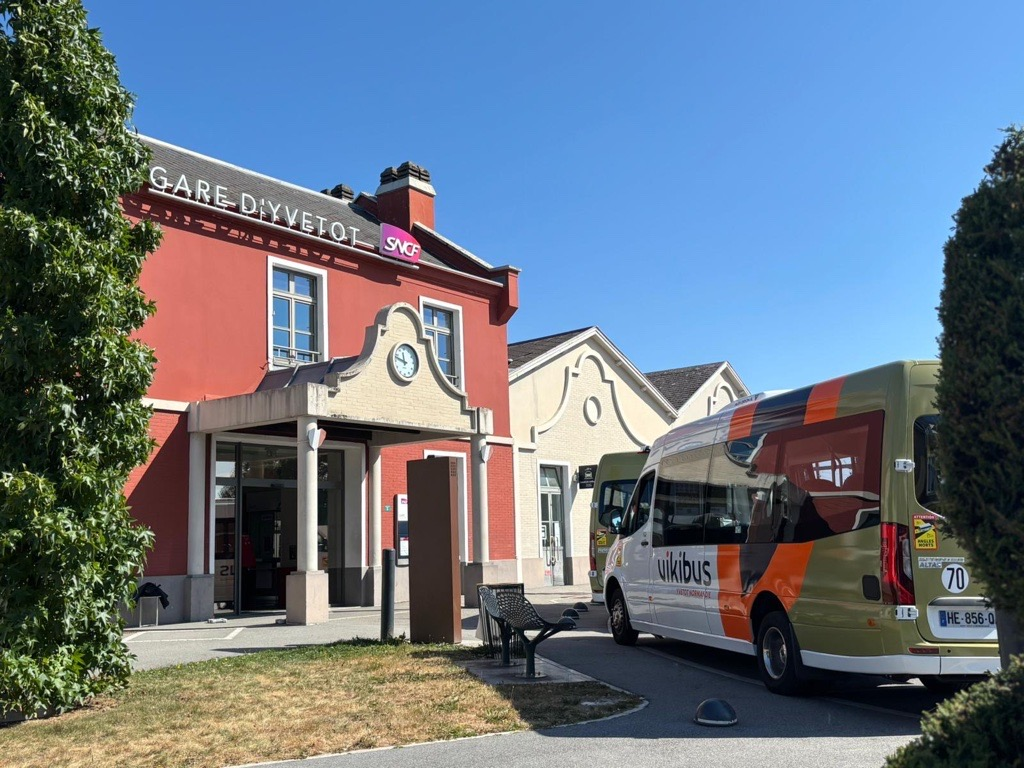
This plan covers a wide range of topics: urban transport, intermodality around Yvetot station (the third-largest station in the département), carpooling, active mobility and parking. A valuable management tool, which made it possible to identify two immediate priorities:
- Restructuring the urban transport network (Vikibus), to better serve business parks, workers and major trip generators;
- Creating a demand-responsive transport service, to open up rural municipalities that had not been served until then.
03Demand-responsive transport: a success beyond expectations
Demand-responsive transport, designed as a feeder service to Yvetot from rural municipalities, quickly found its audience. In less than a year, the targets set were exceeded by 150%, with more than 2,000 registered users at the end of the first year and steady monthly growth.
This success is down to several factors:
- A well-defined offer. Rather than launching an unlimited service at the risk of soaring costs, the Communauté de communes chose a deliberately structured approach: defined feeder points, controlled time slots, two distinct geographical zones. A philosophy summed up simply: “It’s better to start with something well defined, then let it evolve.”
- Multichannel, local communication. Flyers distributed in the municipalities, speeches at the mayors’ New Year greetings, QR codes in schools, a presence on social media… According to Astrid Bigault-Dam, the involvement of rural elected officials was decisive. Some mayors personally promoted the service to their residents, even accompanying the first users to help them feel comfortable with the service.
- A digital tool accessible to all. The service offers both an online booking platform and a telephone helpline. In an area with a high proportion of seniors, this dual approach proved essential: even today, around a third of bookings are made by phone. The driver dedicated to demand-responsive transport plays a social role in his own right, often one of the few people some users talk to during the day.
04Digitalisation: a lever, not an end in itself
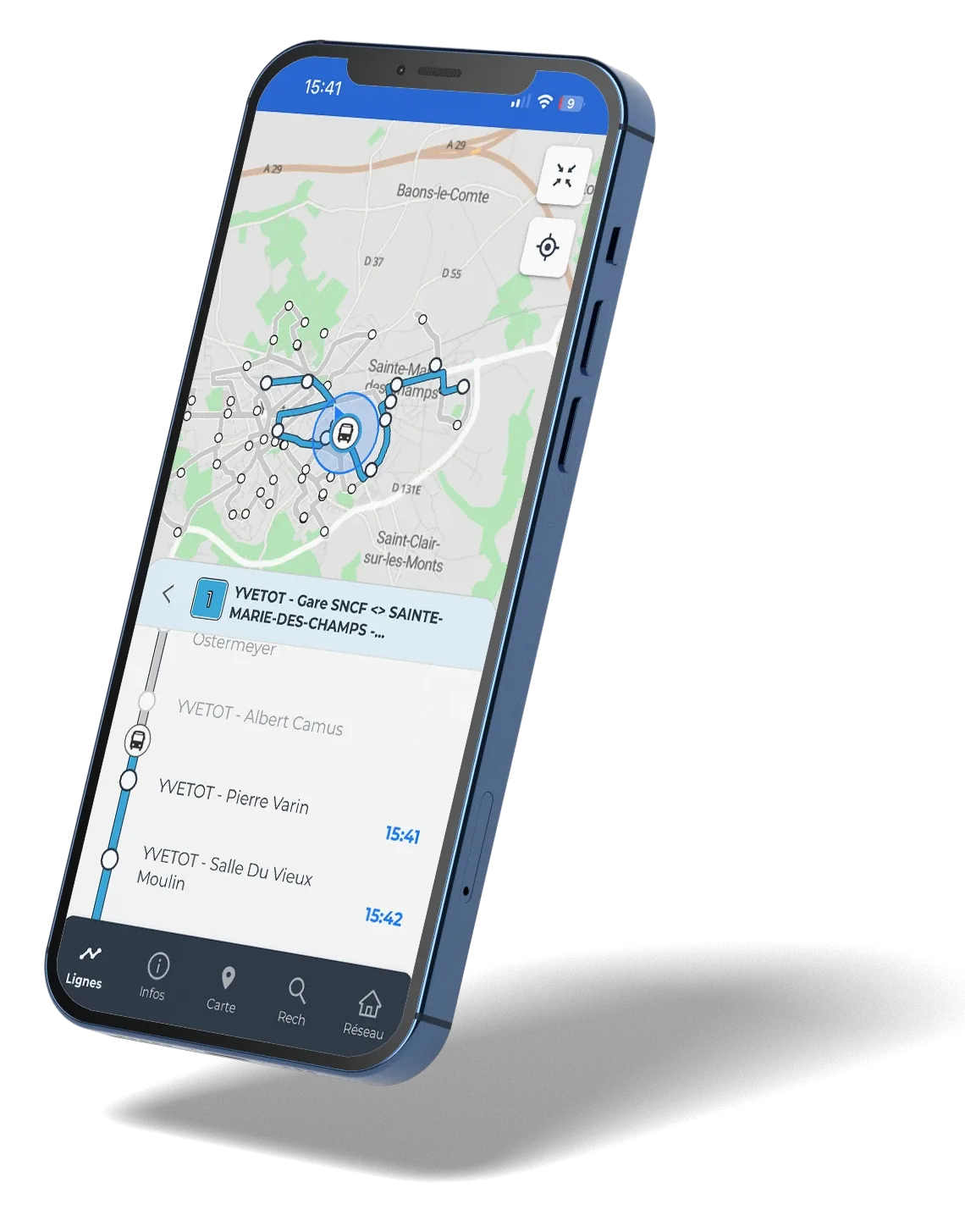
The network overhaul was an opportunity to thoroughly modernise passenger information. Real-time bus tracking, a mobile app, a dedicated Vikibus web page, a presence on social media: all tools that have transformed the user experience.
The concrete result: complaints have dropped drastically. When a diversion or disruption occurs, passengers are informed instantly and no longer need to call the Communauté de communes. “It has really changed things,” says Louis Mazars, Sales Director of Cars Hangard.
However, digitalisation has not come at the expense of accessibility. The aim remains to reach all audiences: young people via the QR code, workers via the app, seniors via the telephone or the physical information point open in Yvetot town centre.
05The ITS: a paradigm shift for passenger information
Before the new public service delegation, the Communauté de communes did have internal access to vehicle geolocation, but passengers travelled without any real-time information. As a result, calls kept multiplying, both to the operator and to the Communauté de communes’ departments, to report a late bus or a missed service.
Implementing the ITS as part of the new delegation profoundly changed the situation. Now, as soon as a diversion is decided or a stop is temporarily suspended (due to roadworks, an obstruction or an incident), the information is pushed directly to passengers via the app. “We know our drivers won’t call us anymore because the passengers on board already have the information,” explains Louis Mazars. Complaints, which were numerous in the first months after launch, are now down to around one per quarter.
Beyond operational peace of mind, the ITS is a real tool for workers and young people. A QR code, a smooth app, a real-time map: these are the essential conditions for a secondary school pupil, a busy commuter or a new resident to adopt the network. Conversely, for seniors less comfortable with digital tools, physical displays at stops and traditional channels remain essential as a complement.
The ITS is therefore much more than a technical tool: it is a foundation of trust on which the relationship between the network and its users rests. And the question raised during the discussion sums up the issue well: “Could we do without an ITS today?” The answer is unambiguous: no.
We know our drivers won’t call us anymore because the passengers on board already have the information.